APPLICATIONS · OIL DENSITY TEST
You sign for a fuel delivery by volume, and that volume was measured by someone else's meter. You change hydraulic oil on a calendar written for the machine, not for the oil in front of you. An oil density test is the cheapest way out of both traps: a few millilitres of sample and one number you can check yourself. This guide covers what that number means, how to sample so it is worth trusting, and what you can decide with it.
What Is an Oil Density Test
An oil density test measures how much mass sits in a fixed volume of oil at a stated temperature, reported in kg/m³ or g/cm³. Density changes as oil warms, so a value without a temperature is half a result. International practice corrects to 15 °C; many Chinese specifications state limits at 20 °C. Keep the basis attached to the number.
Two companion values come out of the same measurement. Relative density compares the oil against water at the same reference temperature, telling you whether water will sink or float in your tank. API gravity is the trading scale for the same property, where higher numbers mean lighter liquid.
▍How Density Instruments Work Together
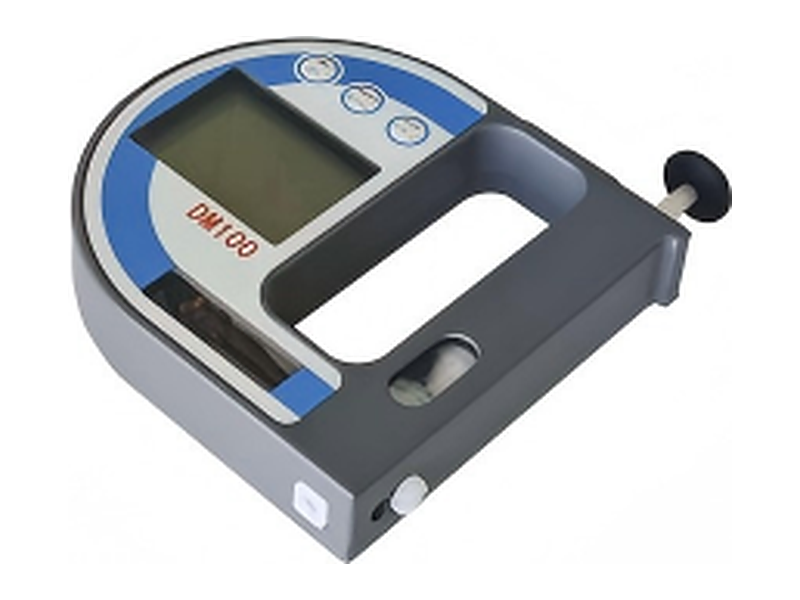
A portable digital density meter holds a small U-shaped glass tube. Fill it, set it vibrating, and the resonant frequency shifts with the mass of liquid inside; density follows from that frequency, and a temperature sensor beside the tube corrects the reading as it happens. The physics is simple. The workflow decides whether the result is worth anything.
Screen, keys and clamp handle on one side of the body
Three steps, in order. Sample handling first: clean syringe, no bubbles, tube rinsed with the product you are about to test. Thermal equilibration second: a sample carried in from a cold yard keeps drifting while you watch it. Measurement last, with the meter converting the observed value to the reference temperature using ASTM D1250. That conversion is what lets your reading sit beside a supplier's certificate or a result from another site.
Key Indicators an Oil Density Test Covers
| Measured quantity | What it answers | Method to confirm |
| Density at reference temperature | Does the product match the grade on the paperwork? | ASTM D7777 on site, ASTM D4052 in the lab |
| Density at test temperature | What is in the tank now, before correction? | Same meter, reported with the temperature |
| Relative density | Will water sink or float in this oil? | ASTM D7777, or ASTM D1298 |
| API gravity | How does it compare with trading grades? | ASTM D7777 with ASTM D1250 |
| Spread across tank levels | Stratified by water, sludge, or a second product? | Top, middle, and bottom samples |
| Repeatability on one sample | Stable enough to act on? | Two or three repeats, same temperature |
Report the number, the temperature basis, and the method together. Any one alone cannot be defended later.
How to Take a Sample for an Oil Density Test
Most bad density results are sampling errors wearing a measurement costume.
• Sample where the decision applies. Top, middle, and bottom for stratification; the running line for a circulating system; the same point before and after a transfer when contamination is the question.
• Flush the point first. The first litre in a dead leg is not the product you are buying.
• Fill slowly. Bubbles are the largest error source, because gas carries almost no mass and pulls the reading low.
• Let the sample reach meter temperature. A cold sample measured warm reads wrong, and it reads wrong believably.
• Rinse with sample, not solvent. A solvent film left in the tube biases the next reading.
• Record sample ID, location, and time. A value with no sample trail cannot settle a dispute.
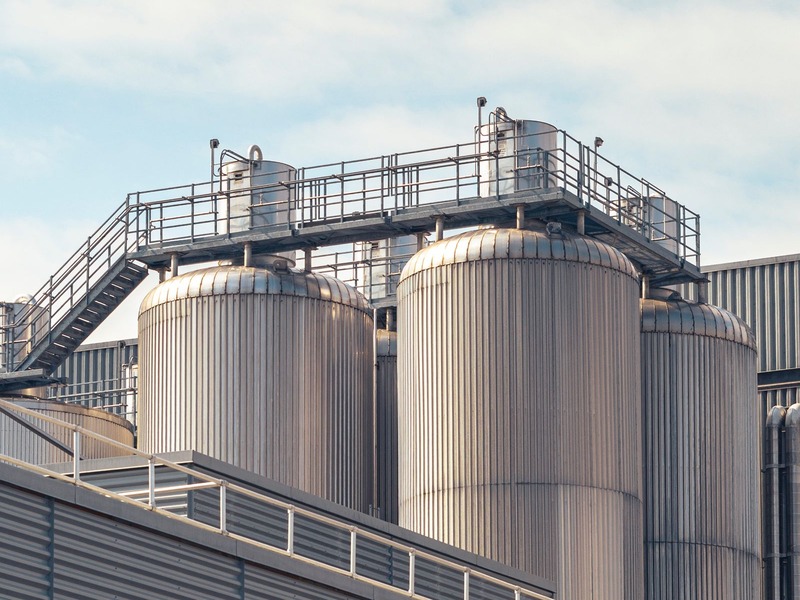
Tank farm and pipe bridges: where you sample decides what the number is worth
ASTM D7777-24 applies to dry vapour pressure up to 80 kPa and viscosity below 100 mm²/s at the test temperature, between 0 °C and 40 °C. Very light or very viscous products need a different method, not a different technique.
Four Ways to Read an Oil Density Test Result
One oil density test yields four answers depending on the question you bring. Knowing which question you are asking keeps you from over-reading a single number.
▍Read It as an Identity Check
Every product family occupies a narrow band. Automotive diesel under GB 19147-2016 must sit between 810 and 850 kg/m³ at 20 °C; most hydraulic and turbine oils fall inside a band you can pin down from the supplier's data sheet. Inside it, you have evidence the product is what the paperwork claims. Outside, you have a reason to hold the tank.
▍Read It as a Quantity Conversion
Meters count volume, but you buy and burn mass. Multiply the corrected volume by the density at the same reference temperature and you have the mass; ASTM D1250 supplies the factors. On a large bunker transfer, a small density error becomes a large money error — which is why custody transfer belongs to ASTM D4052 in a laboratory, not a handheld meter at the manifold.
▍Read It as a Contamination Signal
Two oils mixed produce a density between them. A lighter product slipping into a heavier one pulls the number down; a heavier residue pulls it up. After a line changeover or a shared hose, this is the fastest check available. Density will not name the contaminant, but it tells you the tank is worth a second look.
▍Read It as a Trend Line
One reading is a data point. The fourth is a trend. Log every result against sample date and the line tells you whether the system is stable, drifting toward heavier contamination, or picking up light ends from a leaking seal.
What an Oil Density Test Can Reveal
| Density observation | What it usually points to | What to cross-check |
| Above the grade band | Heavy fraction, residue, or another product in the line | Viscosity, distillation, flash point |
| Below the grade band | Light fraction, solvent, or gasoline carry-over | Flash point, viscosity, vapour pressure |
| Normal density, climbing viscosity | Oxidation or soot, not contamination | Viscosity trend, insolubles |
| Levels disagree | Water layer, sludge, or two products | Water content, bottom sample |
| Shift across one delivery | Cross-contamination during transfer | Before and after samples |
| Repeats scatter | Entrained air, emulsion, or poor flushing | Re-sample, re-measure |
Tank condition is invisible from outside; density shows the spread across levels
Reading Oil Density Test Trends
▍A Diesel Delivery That Reads Heavy
Example: A terminal receives a batch declared as 0# diesel, specified at 810–850 kg/m³ at 20 °C. An oil density test at the unloading line returns 862 kg/m³ — outside the band and above it, pointing to a heavier fraction rather than water. You retain the sample and send it for confirmation by ASTM D4052 before accepting the load. One reading did not prove the cause; it told you not to unload blind.
▍When Volume and Mass Disagree
Example: A fuel oil transfer is invoiced by volume. You measure density at the manifold, correct to the reference temperature, and convert. If the mass comes out a percent or more below the delivery documentation, the gap is worth investigating: entrained air, a temperature argument, or a genuine short delivery. Density turns an argument into arithmetic.
▍A Hydraulic System That Slowly Drifts
Example: A hydraulic oil reads 0.868 g/cm³ in January and 0.874 g/cm³ in April, with viscosity up by roughly the same proportion. Density and viscosity moving together usually means a heavier oil entered the system, or the oil is oxidizing into thicker products. Density alone is a curiosity; density plus viscosity is a work order.
What to Do With an Oil Density Test Result
Most articles list "five benefits of density testing." Here is a sharper question: once the number is on the display, who acts on it, and how?
• The receiver. Read the load before unloading: inside the grade band, release it; outside, hold it — today, not in three days.
• The terminal supervisor. Read before and after every transfer; a step change is a contamination clue. Quarantine first, assign blame later.
• The maintenance engineer. Read density with viscosity and change oil on trend, not on calendar.
• The auditor. Sample ID, timestamp, and reference temperature make every number traceable to a person and a tank, months later.
The trade-off is honest: a portable reading screens and verifies, it does not referee. For contract quantities, the laboratory method is the one that stands up. Used together, the meter decides what to send to the lab, and the lab decides what the contract says.
Receiving, handover and inspection all happen at the tank farm; each role reads the number once
Oil Density Test: Frequently Asked Questions
Q | Density, Relative Density, or API Gravity?
Same property, three scales. Density is mass per volume, relative density compares the oil with water, and API gravity is a trading convention. Convert rather than measuring three times.
Q | Why Does Temperature Change the Result?
Oil expands as it warms, so the same mass fills more volume and density falls. That is why results are corrected to a common reference before anyone compares them.
Q | What Do Bubbles Do to the Reading?
They lower it. Gas contributes almost no mass, so an air pocket makes the liquid look lighter than it is. Slow filling catches most of it.
Q | How Reliable Is a Field Reading?
ASTM D7777-24 is written for field verification, and the laboratory method resolves finer. Enough for grade checks and trending; for invoicing, use the laboratory.
Q | Can You Use It for Custody Transfer?
No. ASTM D7777-24 states that it is not intended for custody transfer quantity calculations. Field readings support operational decisions.
Q | Is One Density Reading Enough?
Rarely. Pair it with viscosity and, where relevant, water content and particle count. Density tells you identity; the other tests tell you condition.
Conclusion on Oil Density Test
An oil density test answers one narrow question, but it supports four decisions: acceptance, quantity checks, contamination screening, and trending. Sample it right, keep the reference temperature with the number, and let the lab settle what a field reading only screens. If you want that first number at the tank instead of three days later, that is what the DM100 handheld density meter is built for: a few millilitres, a couple of minutes, and a reading you can carry back to the office. Ready to build Fix your sampling points and reference temperature before the next delivery. To choose a meter or set up a test procedure, look at the DM100 density meter, or get in touch with us.